.jpg)
5 Common GST Notices and How to Respond
- admin
- 01-Jan-1970
.jpg)
.jpg)


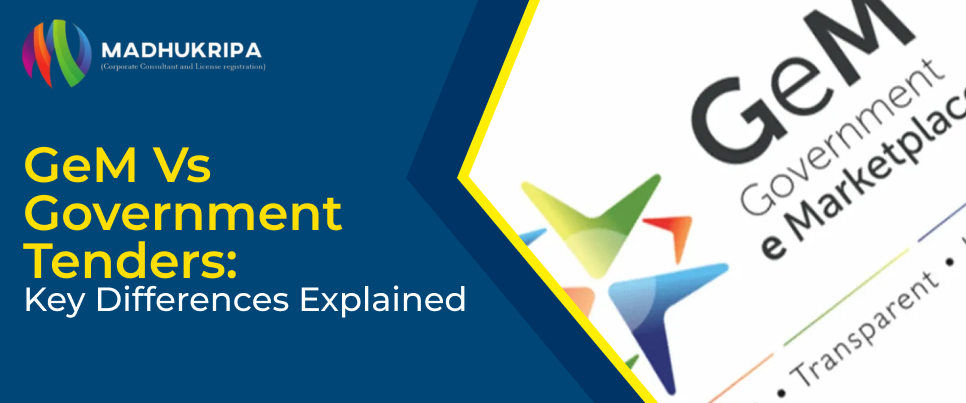



GeM vs Government Tenders: Key Differences for Businesses
Each year, the government, PSUs, and other public organizations procure a variety of items, services, and works. The participation of businesses in this procurement process can happen through GeM, government e-tendering portal, and other authorized procurement channels. While these platforms are somehow linked with government procurement, their processes, eligibility criteria, and opportunities may differ significantly.
There is confusion among many MSMEs, startups, traders, service providers, and contractors about whether to concentrate on GeM or the government tenders. The understanding of both procurement processes will enable business to make a wise decision and avoid unnecessary errors.
At MadhuKripa Co. Consultant, we assist MSMEs, startups, traders, service providers, and contractors in understanding the government procurement processes and participating in the suitable ones. This guide highlights the differences between GeM and government tenders in easy-to-understand language so that businesses can make an informed choice in 2026.
GeM means Government e-Marketplace and is an online system established by the Government of India to expedite government procurement and remove paperwork altogether. Instead of filing lengthy papers, vendors offer their goods and services directly through the platform and they get purchased according to certain parameters. It was introduced to eliminate middlemen, shorten processes and provide a level playing field to small enterprises in dealing with the government directly without much documentation and personal connections.
The sellers get registered at the portal with their PAN, GST, banking details, and other necessary documents. They place their goods or services in the available category specifying their prices. In case the buyer has any requirement that is listed on the GeM, the portal provides the buyer with choices like direct buying, competition, and even reverse auctions. Vendor rating, performance record, and payment online are included in the process. The documentation becomes easier and faster for standard goods and services.
Government tenders are bidding opportunities that are released by government ministries, PSUs, municipalities, and any other government body through the process of government tenders. The opportunity might be announced through any e-tendering portal at the central level, state level, departmental level, PSU level, or any other level.
The tender usually contains the buyer’s requirement, eligibility criteria, technical specifications, financial specifications, bid submission date, and many other conditions. Those firms which satisfy the conditions can make their submissions within the stipulated time frame.
Government tenders are widely used for construction, infrastructure, EPC contracts, professional services, consultancy, maintenance works, and any other requirements.
The entire process begins with the definition of the requirement and the issuance of the notice by the purchaser. Firms interested in the tender conduct a careful analysis of the requirements and submit their bids before the specified date. The evaluation committee conducts the technical feasibility analysis after opening the bids. Only those that are technically feasible go through financial analysis. Finally, award letters, agreements and performance security are issued. The whole process is usually long lasting weeks or months depending on the work involved.
The major difference between GeM and government tenders is the procurement ecosystem. Identifying the key differences will help a business understand where to start investing its efforts.
GeM uses standardized catalogues and platform formats. Suppliers generally maintain their registration and listings up to date. Tenders require elaborate technical and financial bids along with performance certificates and various declarations. Just one missed document or minor discrepancy may result in failure.
GeM uses automated processes and defined rules for procuring, which makes a number of procurements faster from the point of requirement to order placement. Traditional tenders include multiple levels of evaluation, pre-bid discussions in certain scenarios and manual scrutiny, which makes the process lengthy.
GeM keeps the door wider open. Registration is straightforward and many categories do not demand long track records. Traditional tenders frequently set minimum turnover, similar-work experience and other thresholds that newer or smaller firms find hard to meet on their own.
GeM works best for standardised goods, common services, office supplies, IT hardware, vehicles, manpower and facility management. Traditional tenders dominate high-value infrastructure, EPC contracts, railway works, power projects, defence requirements and complex consultancy assignments.
Both try to ensure transparency. GeM ensures that prices, ratings of vendors, and digital audit trails are visible in real time. In case of traditional tenders, notices and results are made publicly available, but the process of evaluation is carried out by committees via document examination and may not seem immediate.
GeM provides online billing and tracking and relatively clear information on payments. Traditional contracts may have lengthy payment terms, performance guarantees and retainage funds that have an impact on cash flow.
The choice of the procurement portal will be based on the type of requirement, category of the product/service, complexity of the project, eligibility conditions, and procurement regulations that apply.
GeM is often chosen by companies for several standard products/services, whereas e-tender portals are preferred for special works, infrastructure, construction, and complex projects.
Examples may include:
The business organizations should first review the eligibility criteria of the tender notice before making a decision.
Also Read: Common GeM Registration Mistakes and How to Avoid Them
There are various opportunities for businesses through government procurement, but it is important that one prepares well for the procurement process. Some of the mistakes made by companies include concentrating on the tender cost only and forgetting about the rules of compliance.
Some common challenges include:
An effective tendering approach will definitely involve opportunity discovery, eligibility assessment, documentation preparation, price assessment, submission verification, and deadline management.
Managing the registration process, listing of products or services, bidding, tenders, dates, and multiple procurement portals may take up much of your time. Even a minor error in eligibility papers or bidding can make a huge difference.
At MadhuKripa Co. Consultant, we will help you navigate through all the facets of government procurement procedures. Our services can include GeM registration, document management, eligibility check, tender identification, and other things related to procurement processes.
Whether you are an MSME wishing to get acquainted with the GeM process or an experienced contractor in need of suitable tenders from the government sector, proper assistance can provide clarity regarding the matter. If you require our GeM and government tender services, please contact MadhuKripa Co. Consultant at +91-9044440777.
Both GeM and government e-tendering give companies chances to take part in government procurement, but the procedures and applications can vary. GeM is the procurement market of the central government that is often used for different goods and services, while other procurement tenders by the government are generally used for specific works, infrastructures, constructions and so on.
The choice will depend on the company type, goods or services it supplies, the eligibility of the company, its experience, finances and the requirements of the procurement opportunity. Prior to taking part in it, the companies need to study all the requirements of the tender or bid, to get prepared with all necessary documents and make an offer within the specified deadline.
GeM is a central government procurement marketplace where eligible buyers can purchase products and services from registered sellers. Government tenders are procurement opportunities issued through GeM, CPPP, state portals, department portals, PSUs, and other authorised procurement systems.
GeM can be suitable for businesses offering standardised products and services, while other government tendering systems are commonly used for construction, infrastructure, specialised services, and complex projects. The suitable option depends on the business type, eligibility, experience, and procurement requirements.
Yes, eligible MSMEs can participate in suitable GeM procurement opportunities after completing the applicable seller registration and compliance requirements. Before bidding, businesses should check the product category, eligibility conditions, technical specifications, required documents, certifications, and other bid requirements.
Government tenders provide small businesses with opportunities to supply products, provide services, or execute eligible works for government departments, PSUs, and other public organisations. Participation depends on the specific tender's turnover, experience, technical capability, financial requirements, certifications, and other eligibility conditions.
GeM seller registration allows an eligible business to create a seller profile on the Government e-Marketplace. After completing the applicable registration process, businesses can list eligible products or services and participate in suitable procurement opportunities. Registration alone does not guarantee an order or contract.
Businesses can find government procurement opportunities through GeM, the Central Public Procurement Portal, state e-procurement portals, government department websites, PSU portals, and other authorised platforms. Regular monitoring helps businesses identify new tenders, corrigenda, deadlines, eligibility changes, and submission requirements.
No, GeM is not limited to manufacturers. Depending on the available category and procurement requirements, eligible traders, service providers, OEMs, startups, MSMEs, and other businesses can participate. Sellers must meet the applicable registration, product, service, compliance, and bid requirements.
The required documents depend on the specific tender. Common documents may include PAN, GST details, business registration documents, financial statements, experience certificates, technical documents, declarations, EMD, certifications, and other documents mentioned in the tender conditions.
CPPP stands for Central Public Procurement Portal. It is a government procurement portal that provides information about tender enquiries, corrigenda, and contract awards from participating central government organisations. It helps businesses find and track relevant central government procurement opportunities.
Yes, GeM supports the procurement of various services in addition to products. Depending on the available categories and buyer requirements, businesses may find opportunities related to manpower, security, facility management, maintenance, consultancy, professional services, and other eligible services.
The GeM bidding process generally involves finding a suitable bid, checking its specifications and eligibility conditions, preparing the required documents, submitting an online offer, and participating in the applicable evaluation or reverse auction process. The exact process depends on the bid and procurement requirements.
GeM may be simpler for some businesses because registration, product or service listing, bidding, and procurement activities are handled through a central digital platform. However, GeM bids can also have strict technical, financial, pricing, eligibility, and documentation requirements.
Yes, eligible startups can participate in government tenders when they meet the requirements of the specific opportunity. Certain procurement policies may provide applicable benefits or relaxations to eligible startups and MSMEs. Businesses should verify the current rules and tender conditions before submitting a bid.
Government tenders can help MSMEs access institutional buyers, expand their customer base, generate business opportunities, and build experience in public procurement. However, the actual benefits depend on suitable eligibility, successful bidding, competition, contract terms, payment conditions, and proper execution of the awarded work.
Businesses looking for assistance with GeM registration, tender identification, eligibility checking, documentation, and bid preparation can consult MadhuKripa Co. Consultant. Professional guidance can help businesses understand procurement requirements and prepare suitable submissions. For assistance, contact MadhuKripa Co. Consultant at +91-9044440777.

.jpg)
.jpg)

MadhuKripa Co. Consultant: Your Trusted Partner for GST, Company, GEM Portal, and Drug License Registration in Lucknow.